In the first two modules, you have learned how to control motors with a velocity demand, you have learned how to locate the positions of brightly coloured objects using vision, you have learned how to get a PC and an Arduino to collaborate on a control task.
But up to now, the motion has been simple and vertical. In this module you will use both motors to control a suspension point, from which hangs a pendulum.
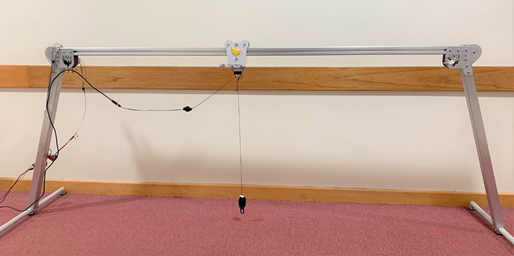
A PhD project on crane control left the legacy of a piece of apparatus.
This has two motors with incremental encoders, one for lateral position and one for height. It also has a downward looking camera, to observe the swinging of the load.
But the nature of modules requires that the equipment can be simple enough that it can be home built for a modest price.
The resulting apparatus has those two motors with incremental encoders, rotating cotton-reel pulleys that connect to a fulcrum object with a V of cottons. Below this swings the pendulum, with a third cotton making a Y.
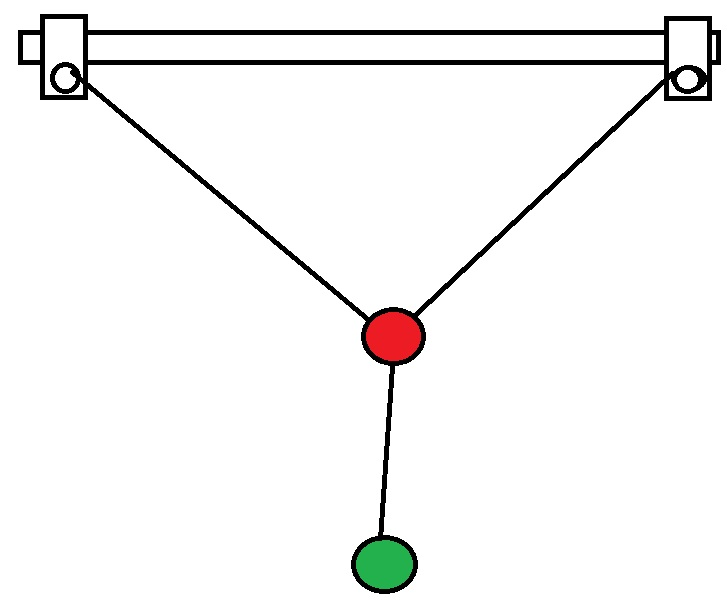
The fulcrum can be a bright red object, maybe a Lego brick, while the pendulum bob is a bright green one.
Your PC camera observes this horizontally, detecting the positions of both pendulum and bob. You might find it more comfortable to attach a webcam, or to use a tablet with front-facing camera.
In the next sections we will explore the dynamics, and the non-linear control strategies that will be necessary.