Many sensors just give you a simple answer, like a voltage from a potentiometer or a simple number. But to get the information that you need, you might have to look at time behaviour or the response to a stimulus.
That intruder would not be detected if he kept completely still.
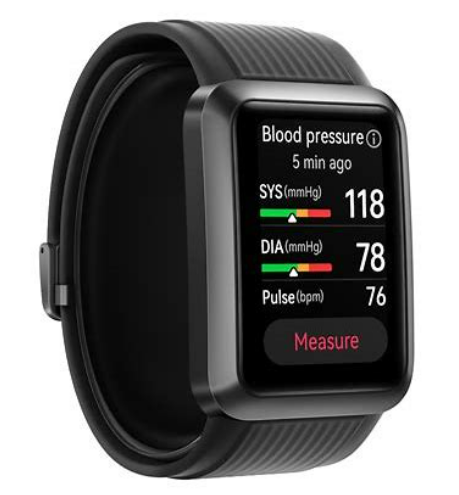
The smart watch heart rate detector depends on shining a light onto the wrist, and looking at the pulsation of the reflection. No problem there. But many watches claim to measure blood pressure by the same method. Can that be accurate?
There is no problem with a watch claiming to act as an ECG (electrocardiograph) because it can measure the minute voltage differences across your wrist, caused by the beating of your heart. But a professional heart waveform monitor measures these differences at many widely spaced points, so the output of the watch must be much more limited.
The purchaser will be happy nevertheless, despite having no idea about how to interpret the data.
A medical blood pressure tester has a cuff that fits around the upper arm, inflated by a pump in the machine to cut of the blood supply. As the pressure is then allowed to fall, measurement of blood pressure involves assessing the pulses in the tube that connects the cuff to the device. Although the standing pressure is allowed to fall quite rapidly between pulses, the machine can measure the instantaneous tube pressure very frequently, and from its waveform deduce when it will fall below the threshold. No problem there.
But the usual smart watch has no way to measure pressure, and has to guess. Yes, it can measure the time history of the reflectivity, both of red and any other colour that it might add, but pressure still has to be a guess.
The smart watch is not sold as a medical instrument, so does not have to make any guarantees about accuracy. Its success is based on how well it can convince the exercising user, not on truth.
If you possess both a smart watch and a blood-pressure tester that has a cuff, perform a few tests to see how they compare.
Ponder on the possibility of improving the accuracy of an ordinary smartwatch, by comparing two readings, one with hand held high and the other with hand downwards.
What would the pressure difference be, in millimetres of mercury?
It is perhaps unfair to include the image of the Huwei watch in my criticism – they have gone one step further. Their watch has a wrist-band that inflates!
If you go anywhere near a hospital, you will get one of these clamped onto your fingertip.
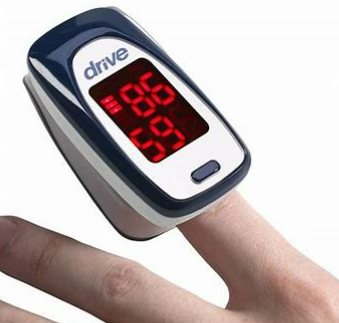
Well-oxygenated blood is bright red, while blood that lacks oxygen is blue. So by alternately flashing the fingertip with red light and blue, the ratio can easily be measured of the reflectivity. That is enough to ensure accuracy for medical use, or even for the devices that you can buy online for a very few dollars. I suspect that some smart watches might also include the feature.
When the Dambusters wanted to know their precise height above the dam water, they used the ingenious expedient of triangulation. Two beams of light of different colours were projected from the front and rear of the aircraft, so that at the right height they would coincide. If they were too high, red might be in front of blue. It is a simple technique to use.
Back in my Cambridge days, I knocked up a sensor for the International Newspaper and Colour Association to measure the flapping of the newsprint web that was feeding into the printer. It was nothing more thana beam of light, shining diagonally onto the web, while its reflection was focused onto a pair of simple photocells.
But triangulation is now common in many commercial sensors, including some devices by ‘Sick’.
Laser Triangulation Sensors, 8015920 (sick.com)
If you have watched any films set in submarines, you will have heard the “ping-blip” sound of ASDIC. An acoustic pulse is sent out and the time is measured until its echo is heard.
In miniature, that is exactly how the range-finders work that can be seen attached to Arduino-driven trolleys. A pulse is emitted at 40 kHz or so, and for a distance of one metre, the reflection is received in just under seven milliseconds.
Have a look at Ultrasonic Rangefinder with Arduino | Little Bird Guides (littlebirdelectronics.com.au) for some details.
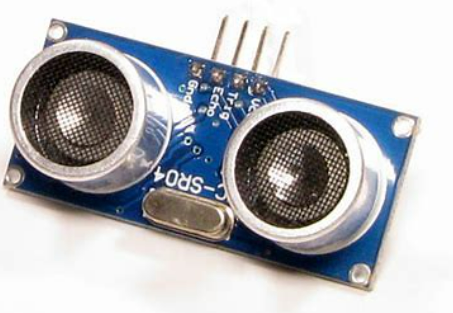
The acoustic range-finder is being upstaged by time-of-flight devices.
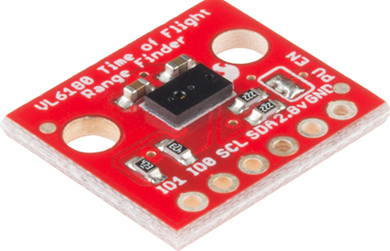
For that same distance of one metre, the optical reflection would be received in just under seven nanoseconds, but that is not too fast for modern electronics. Sweeping the modulation frequency of the laser beam can simplify the measurement task considerably. On beating the return signal with the outgoing signal, a beat frequency can indicate distance.
But they are not mere Sparkfun playthings to attach to Arduinos, they are part of a serious tool for surveyors and house agents.
Time-of-flight is obsessing the minds of those trying to develop autonomous cars. A few decades ago a device came onto the market as a more secure way to detect intruders in a hazardous area. It was the Sick Sensor.
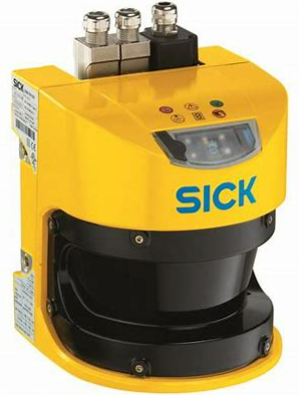
This is the one that I was faced with, when finding a way to measure up airport parcels, but the sensors have developed a long way since.
The idea of projecting a laser beam and timing its reflection still holds, but here that beam is swept around by a spinning mirror. They are not cheap.
A human driver can steer safely, if somewhat nervously, on a dark and rainy night, when the only sense is the sight of a row of cats-eyes in the centre of the road. I suspect that machine vision will give these sensors a hard run for their money.
A much cheaper device was launched that produces depth over a whole 2D scene. It exploits time-of-flight, but gets its result by projecting an array of dots.
There is an explanation at https://www.neuralword.com/en/article/understanding-kinect-how-does-it-work-and-its-features-explained which might not answer all your questions.
The original Kinect is now discontinued, but Microsoft has released a version for developers. That one is not cheap.
Buy the Azure Kinect developer kit – Microsoft
There are a vast number of things that can be sensed with a little ingenuity. There has been USQ research on an olfactometer, a ‘smellometer’ for investigating complaints of farming odours. Almost every wall clock will also tell you about temperature, while some can show humidity. Vibration, 3D acceleration, magnetic compass readings and noise level are all part of the accepted stock-in-trade.
But there is one input that has not been mentioned yet, and that is the most important one of all. The next section is devoted to it.